Pregnant in Gaza, she was dreading labour pains. They came early
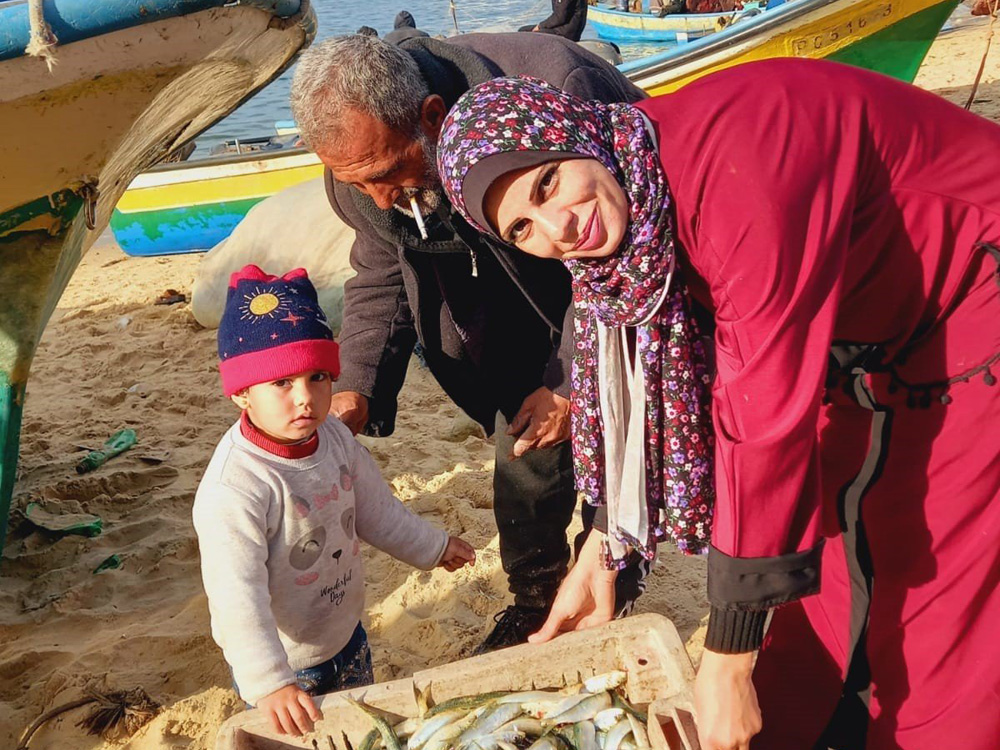
Madleen Kolab
Nine months pregnant, Madleen Kolab huddles in a crowded apartment in southern Gaza with dozens of others seeking refuge from Israeli airstrikes.
In addition to the danger from above, more than a week into the war between Israel and Hamas, Kolab is also dreading the start of contractions.
A few days earlier, Kolab, a local folk hero known as Gaza’s first fisherwoman, had been sheltering with her family in their small home in Shati, a refugee camp near Gaza City where more than 90,000 residents recently lived in a pocket just over half a square kilometre in size.
“I do not know what I will do,” the 29-year-old told the Star, in the first of several exchanges. “There is no safety anywhere.”
A world away, Nancy Murphy, a holistic doula based in Victoria, B.C., has been anxiously checking her phone for updates from Kolab, who, despite the pair having never met, has become a close friend.
A few years ago, they connected on social media after Murphy learned of Kolab’s decision as a girl to become a fisher, and challenge traditional gender norms in the process.
Then for several days last week, Kolab stopped replying. “Are you OK?” Murphy frantically asked. “Are they bombing again?”
When she finally resurfaced, Kolab was far from home.
After she heard a neighbouring building might soon be struck, her family, including Kolab’s three young child, fled their home in the middle of the night. Suddenly, they were homeless – their “most difficult days.”
She then spent two days in a crowded hospital, suppressing pregnancy pains until she fled northern Gaza for the south in a small bus, one among hundreds of thousands of Gazans who have left their homes in recent days ahead of an anticipated Israeli ground invasion.
“It seems that my body is accustomed to fatigue,” she wrote after her family, and several others, were welcomed into the home of her husband’s relative in the southern city of Khan Younis over the weekend.
But she still worried about her pale and yellow complexion; her back and swollen feet ached with pain. In recent days, her family had mostly subsisted on rice, stale bread, biscuits and juice, though she had managed to find some chocolate for the children.
“Whoever sees me would not say that I am carrying a child in the ninth month.”
Kolab’s exchanges with the Star over Facebook were translated from Arabic.
Since Hamas’s brutal, multifront attack on southern Israel Oct. 7, which killed more than 1,400 people, mainly civilians, Israeli warplanes have pounded the Hamas-controlled Gaza Strip with thousands of bombs in an effort to destroy the military capability of the group considered a terrorist organization by Canada, the U.S. and the EU.
Israeli strikes have killed at least 2,778 people, with children comprising nearly two-thirds of the dead, according to Medhat Abbas, a Gaza Health Ministry official. Those figures do not include the hundreds estimated to have been killed by an explosion Tuesday at a Gaza City hospital. Hamas quickly placed blame on an Israeli airstrike. But Israel has staunchly denied responsibility, releasing audio and aerial footage it says points to “a failed rocket launch” by the Islamic Jihad, a Gaza-based militant group.
On Wednesday, United States President Joe Biden announced that Israel would begin allowing limited aid into Gaza, home to 2.3 million people, nearly half of whom are children. In the aftermath of Hamas’s attack, Israel cut off the flow of food, fuel and water into Gaza. But as aid workers warn that Gaza is nearing total collapse, it remained unclear when the much-needed humanitarian assistance would be let through.
Although the Israel Defence Forces had begun to urge northern residents to seek refuge in the south last week, dozens were killed in airstrikes in southern Gaza on Tuesday.
“It was a difficult and terrifying night,” Kolab told the Star on Tuesday, adding that an apartment building across from where her family is sheltering was bombed.
“We want to live in freedom,” she said. “We want to be there to receive our children like the children of the world. We want to buy toys for children so they can live their childhood. We want to live in a habitable house. We want to live like humans.”
As a teenager, Kolab, the eldest of her siblings, took it upon herself to feed her family after an injury put her father, a veteran fisherman, out of work. Paddling out to sea in a shallow-hulled boat, she soon became known as Gaza’s first, and only, fisherwoman.
Despite a cool reception from her fellow (and male) fishers, the confident teen would earn their respect. “I found she was more capable than a man,” Mohamed Omar Bakir told Al-Jazeera in a 2017 documentary about Kolab. “She doesn’t count as just one man but as five.”
However, working on the water also exposed how the Israeli occupation severely hinders the livelihood of Gazan fishers, who face arrests, confiscated equipment and regular confrontations at sea with Israeli forces that have, at times, turned deadly. Strict limits on where Gazans can fish, patrolled by Israel’s navy, have resulted in overfishing and shrunk their catch.
Israel withdrew from Gaza in 2005, but the territory is still considered by the UN to be occupied in part because Israel imposed a blockade in 2007, the same year Hamas began ruling the enclave.
Despite their language barrier, Murphy and Kolab have developed an unlikely but “natural” bond, said the Canadian. They exchange translated messages most days. Murphy has supported Kolab through her recent pregnancies and frequent hardship, while Kolab has been a source of strength for Murphy, whose daughter, now in palliative care, has long suffered from a debilitating, chronic illness that has often required hospitalization.
“We help each other as moms trying to protect our children,” said Murphy.
In messages exchanged between Kolab and Murphy near the beginning of the war, the doula asked if her Palestinian friend had access to strong scissors to cut the umbilical cord in case the baby comes.
“Yes,” Kolab responded. “But I hope the war will end beforehand.”
Then came the news on Wednesday, a few hours after a previous version of this story was published online: Kolab had just given birth to a healthy baby girl, a week before her due date.
Weighing just over seven pounds, she was named Wasila.
Kolab had managed to make it to a nearby hospital just in time thanks to the Red Crescent, an affiliate of the Red Cross. The baby arrived an hour later, but soon they had returned to the building where the family is sheltering, with Wasila wrapped in a pink swaddle.
Kolab asked the homeowner who had taken them in if she could borrow some money for food and medicine.
“I told him that if we survive, I will pay him back.”
This story appeared originally in the Toronto Star