An ode to folk rock legend John Prine, who died five years ago — and my dad, who loves him
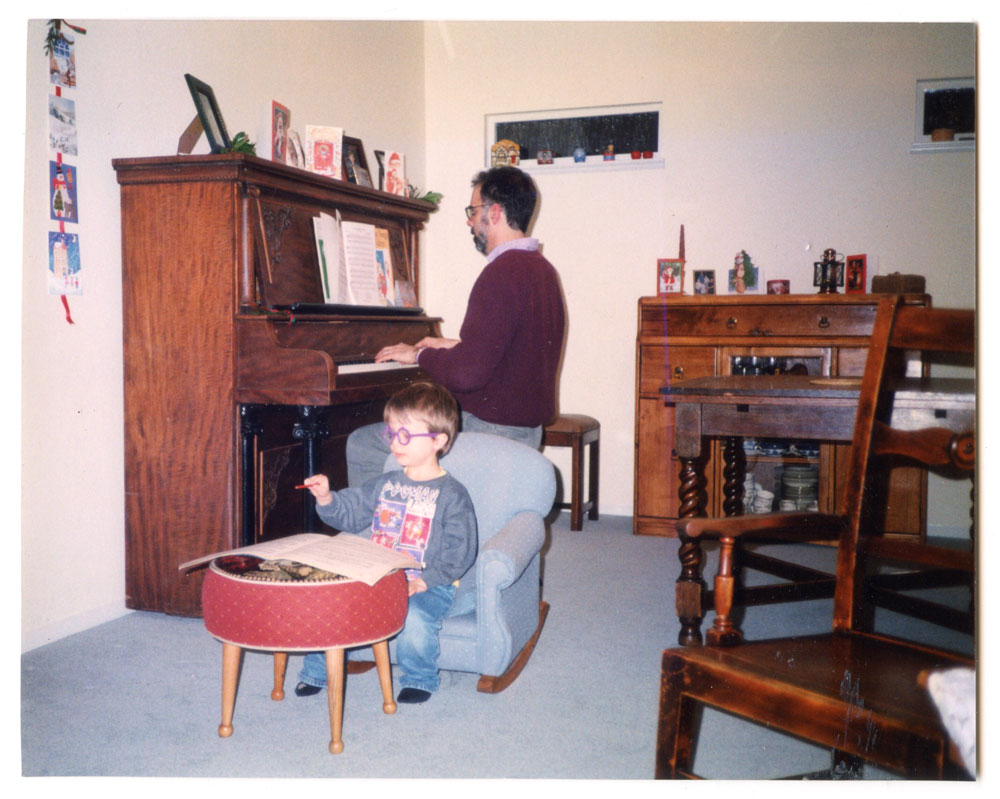
Mussett Family
When I was a kid, my dad and I would drive out to the fallow fields of British Columbia’s Fraser Valley so he could pull off to the side of the road and take photos of nothing.
For decades, my father worked as a commercial real estate appraiser, a tedious profession that I’ve never seen depicted in any movie, book, show or song. Farmland, or rather assessing its property value, was his specialty.
I was usually bored during these expeditions, the scenery outside my window a blur of yellow, green and brown. What made matters worse was the sound coming from the speakers, this nasally singer that my dad loved. His name was John Prine.
To me, Prine’s music — especially his early stuff — sounded brittle, sparse, that unmistakable voice too off-kilter. Smash Mouth made a lot more sense to nine-year-old me. I must not have been listening to the words.
It didn’t click then, but my dad’s navy Honda Accord turned out to be an incubator for my future folk rock fandom. Prine’s songs had burrowed into my head. By my late teens, I was a devotee, awed by the ease at which this former mailman from Maywood, Ill., could spin deceptively simple stories about everyday life that were both funny and poignant, and often delivered in a drawl that sounded like it was being sung through a smile.
“Pure Proustian existentialism,” was how Bob Dylan once described Prine’s songwriting. “Midwestern mind trips to the Nth degree.”
More than two decades after those drives to the country, I keep going back to Prine. As a lapsed Anglican, it’s no exaggeration to say that folk and country music is the closest thing I have to religion, that the swell of pedal steel activates something in me like little else. I guess the late John Prine is my patron saint.
This Monday marks the fifth anniversary of Prine’s death. A few weeks into the pandemic, he died in Nashville, almost exactly two years after releasing a song about what he’d do when he got to heaven, including seeing “all my mama’s sisters,” kissing a “pretty girl on the tilt-a-whirl” and “smoking a cigarette that’s nine miles long.” Complications from COVID took him. He was 73.
A few days before he died, I was cycling through Kitsilano, filling my lungs with fresh air after being stuck at home, when my dad texted to let me know Prine was in critical condition.
The fact he was texting at all was notable. My dad’s a stubborn Luddite. He can be quick to make a joke, but he’s also a bit distant and rarely earnest, a big-hearted man who cares a lot about his family but doesn’t seem to know how to say it. It’s a quality I share, to some extent.
And it’s a contrast to Prine who, in his songwriting, was able to “cut right to the heart of things, as pure and simple as rain,” as described by Bonnie Raitt, another favourite of dad’s.
Shortly after Prine’s death, I called my parents. “We’re headed to a John Prine concert,” my mum said as she answered the phone. Well, not quite. A neighbour on their tiny island off the West Coast was playing a set of Prine classics from his front porch. (A similar tribute happened in Toronto.) My mum held up her phone so I could hear “Hello in There,” a song about the loneliness of growing old — a reality the pandemic had only intensified.
Like just about everything that spring, Prine’s death felt surreal. But it wasn’t a surprise. He had spent nearly two weeks in the hospital battling the illness. Two decades earlier, squamous cell cancer had taken a chunk out of his neck and added an ounce of gravel to his voice. A few years later, he beat lung cancer.
His death still stung. If anyone could have captured the strange moment we found ourselves in — the toilet paper hoarding, the rampant bread baking, the social distancing and longing that came with it — it was Prine.
His songs reflected the absurdity of life. They were relatable but somehow didn’t feel trite. Silly and snarky and sentimental, sad yet uplifting, and often all at once. (“You’re up one day and the next you’re down. It’s half an inch of water and you think you’re gonna drown.”)
If Prine was known for anything, though, it was empathy. He seemed to intimately understand us. “He could tell you about a person in one line,” my dad said in the wake of Prine’s death. And he’d been doing it since he began releasing music in 1971.
On “Angel from Montgomery,” he sings from the perspective of an “an old woman named after my mother” whose “old man is another child that’s grown old.” This line, and the sincerity with which he delivers it, has stuck in my head for years: “How the hell can a person go to work in the mornin’ and come home in the evenin’ and have nothin’ to say.”
As the New Yorker noted a day after Prine’s death, he was just 24 years old when he recorded it: “What did he know about being an old woman? Everything, somehow.” Singer-songwriter Jason Isbell put it this way: “If the artist’s job is to hold a mirror up to society, John had the cleanest mirror of anyone I have ever known. Sometimes it seemed like he had a window, and he would climb right through.”
Looking back on those sunny afternoons in the Honda, I find myself thinking that they’d have made good fodder for one of Prine’s songs. What would he see in my father, I wonder. What would I learn about this reserved real estate appraiser with the salt-and-pepper beard who takes pictures of nothing?
I was lucky enough to see Prine perform in 2016 at Vancouver’s Vogue Theatre. During “All the Best,” a highlight off his 1991 record “The Missing Years,” I noticed — stunned — my dad was crying. I’m not sure we ever talked about it.
My father, who turns 70 this summer, may not always have the words. But Prine’s certainly move him. It’s something we share. For that, I’m grateful. Thanks, John. And thanks, dad, for introducing me to him.
This story appeared originally in the Toronto Star